2026 NFL Draft Review: AFC East
Potential vs Impact
By: Ian Stuart Martin · 4mo
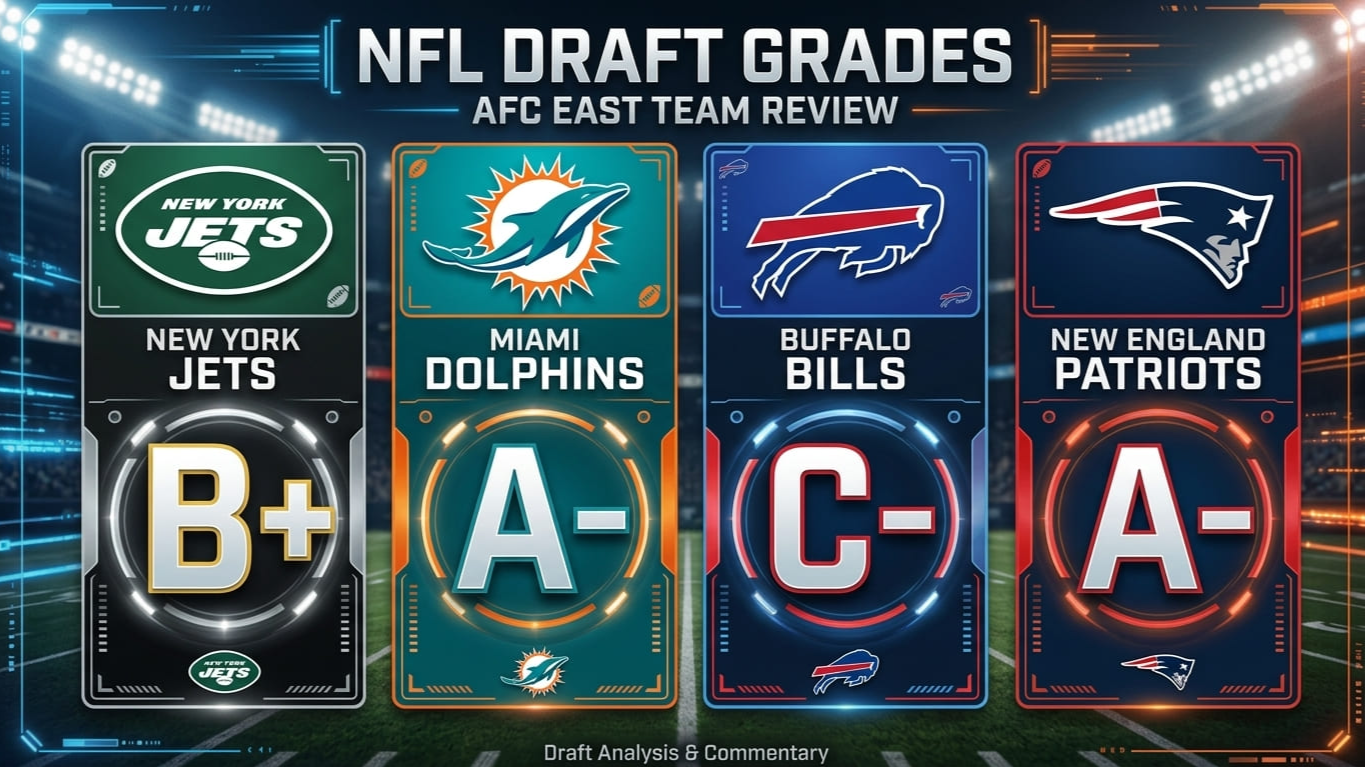
The AFC East took center stage in this year’s draft, with each team approaching roster building in a very different way. From aggressive rebuilds to depth-focused strategies around established stars, these classes could shape the division for years to come. Here’s a breakdown of how the Jets, Dolphins, Bills, and Patriots performed and what it means moving forward.
New York Jets
Grade: B+
The Jets revamped their defense with free agency and the addition of Texas Tech’s David Bailey. He is a proven edge rusher with elite speed and bend. Second-round Indiana corner D’Angelo Ponds won’t replace Sauce Gardner but could develop into a CB1. Florida State DT Darnell Jackson Jr. is massive but lacks agility and needs to develop his hands and footwork to become a starter. The defense now has promising prospects to help them rebuild, and fits a timeline that adds a QB later.
On offense, adding Oregon TE Kenyon Sadiq and Indiana WR Omar Cooper Jr. in the first round lightens the burden for WR1 Garrett Wilson. Clemson QB Cade Klubnik probably won’t be the long-term answer but could develop into a solid backup. Florida guard Anez Cooper and Kansas State safety VJ Payne bring good size, strength, and toughness, but lack elite agility for their positions.
The Jets brought in some great prospects, but the coaching staff needs to show they can develop them. Looking at the first-rounders: Bailey needs to improve his run defense. Sadiq needs an offensive mind to use him, or he could become another Kyle Pitts. Omar Cooper Jr. has great traits but needs to sharpen his route running to succeed against NFL defenders. The Jets need long-term development plans for each prospect in order to maximize them. This may stretch the Jet’s, especially on the offensive side of the ball.
Miami Dolphins
Grade: A-
It’s always a good idea to swing for the fences in the NFL Draft. The Dolphins swung 13 times. First-rounder Kadyn Proctor from Alabama is being slid inside to guard, and barring right tackle Austin Jackson’s health, the Dolphins have a promising offensive line. Texas Tech WR Caleb Douglas, Louisville WR Chris Bell, and Missouri WR Kevin Coleman Jr. fill the nearly empty wide receiver room with youth and energy. QB Malik Willis has support around him to succeed even after trading WR Jaylen Waddle.
On defense, 27th overall San Diego State product Chris Johnson is one of the best zone corners in the draft and a scheme fit. Texas Tech LB Jacob Rodriguez, Pittsburgh LB-turned-safety Kyle Louis, Texas safety Michael Taaffe, and Texas DE Trey Moore are all great defensive prospects who don’t have sky-high ceilings but can develop into a core of dependable starters.
In addition to their other draft picks, nine UDFAs were signed to the roster. Fully rebuilding a team requires getting talent in the building. Adding as many prospects as possible with diverse tools and skill sets lets a team find an identity. In several years, this team will be rejuvenated and ready to compete. The Dolphins have embraced the rebuild and, while not taking the best available player every pick, will have several franchise-building blocks from this group.
Buffalo Bills
Grade: C-
Trading back to acquire more picks was a smart move by the Bills. However, it’s important the Bills don’t “reach” and instead select solid players who can help franchise QB Josh Allen. The 35th overall pick was Clemson edge TJ Parker. He is a solid run defender with great power. Bradley Chubb will be a good mentor as Parker polishes his pass rush and adds more moves.
After Parker, the Bills selected Ohio State CB Davison Igbinosun. He is the big, long, physical press corner the Bills want, but his negatives are concerning. His agility is average, and he frequently compensates by being too physical. Igbinosun had penalty issues early in his college career. He has improved but still over-relies on his hands. He needs to improve his route and play recognition. He could be a solid zone corner, but the Bills could have taken immediate-impact nickel Keionte Scott from Miami or injured but high-upside Jermod McCoy from Tennessee.
Connecticut WR Skyler Bell has proven production, great route running, and solid agility to be a future starting slot receiver. South Carolina safety Jalon Kilgore, a good run-defending nickel/strong safety, and Missouri CB Toriano Pride Jr., a good rotational corner/nickel, bring complementary skills that will allow the Bills’ defense to run a more versatile coverage scheme. Texas A&M OT Ar'maj Reed-Adams will be a solid sixth offensive lineman from the seventh round. However, Boston College OT Jude Bowry, TCU LB Kaleb Elarms-Orr, and Penn State DT Zane Durant were drafted based on tools over production. A team with Josh Allen can certainly take developmental prospects, but most of these players need time to develop. They won’t be immediate rotational impact players. The Bills need to maximize every year of Allen’s prime.
New England Patriots
Grade: A-
The Patriots had a really solid draft. At 28th overall, they got the versatile Utah OT Caleb Lomu. He has solid tape in the run and pass games. He can move inside to guard in case of injury and could even challenge RG Mike Onwenu for the starting job. Long-term, he is the replacement for 35-year-old right tackle Morgan Moses. Adding developmental, versatile depth to a solid offensive line is how a line stays strong for years.
Illinois’ edge Gabe Jacas in the second round is an excellent scheme fit. He lacks speed, but his strength, developed pass-rush moves, and leadership should be great for Head Coach Mike Vrabel to work with. Notre Dame’s Eli Raridon is similar to Jacas. Raridon isn’t a flashy, hyper-agile receiving tight end, but he has grit, receiving instincts, and solid run-blocking. Wake Forest’s Karon Prunty is a bit of a reach, but getting a six-year college player with solid stats as a rotational defensive back is a solid pickup. Texas A&M’s Dametrious Crownover has the size, movement, and strength to be a good offensive tackle, but he needs a lot of work. Still, stockpiling a young sixth-round prospect on a strong line could pay dividends.
Later in the draft, the Patriots mostly targeted high-floor backup and special teamers who could develop into rotational players: Boston College edge Quintayvious Hutchins, TCU LB Namdi Obiazor, and Alabama RB Jam Miller. Texas Tech QB Behren Morton, in the seventh round, has major injury concerns and an average arm, but has the dogged mentality the Patriots love. He could be a franchise favorite backup. Overall, the Patriots added quality contributors to an already strong roster. Non-flashy picks don’t make headlines, but it does insulate them against injuries and set them up for another deep playoff run.


Comments:
Log in or sign up to read and post comments.