2026 NFL Draft Review: AFC South
Who's Best Positioned For Long-Term Success?
By: Ian Stuart Martin · 5mo
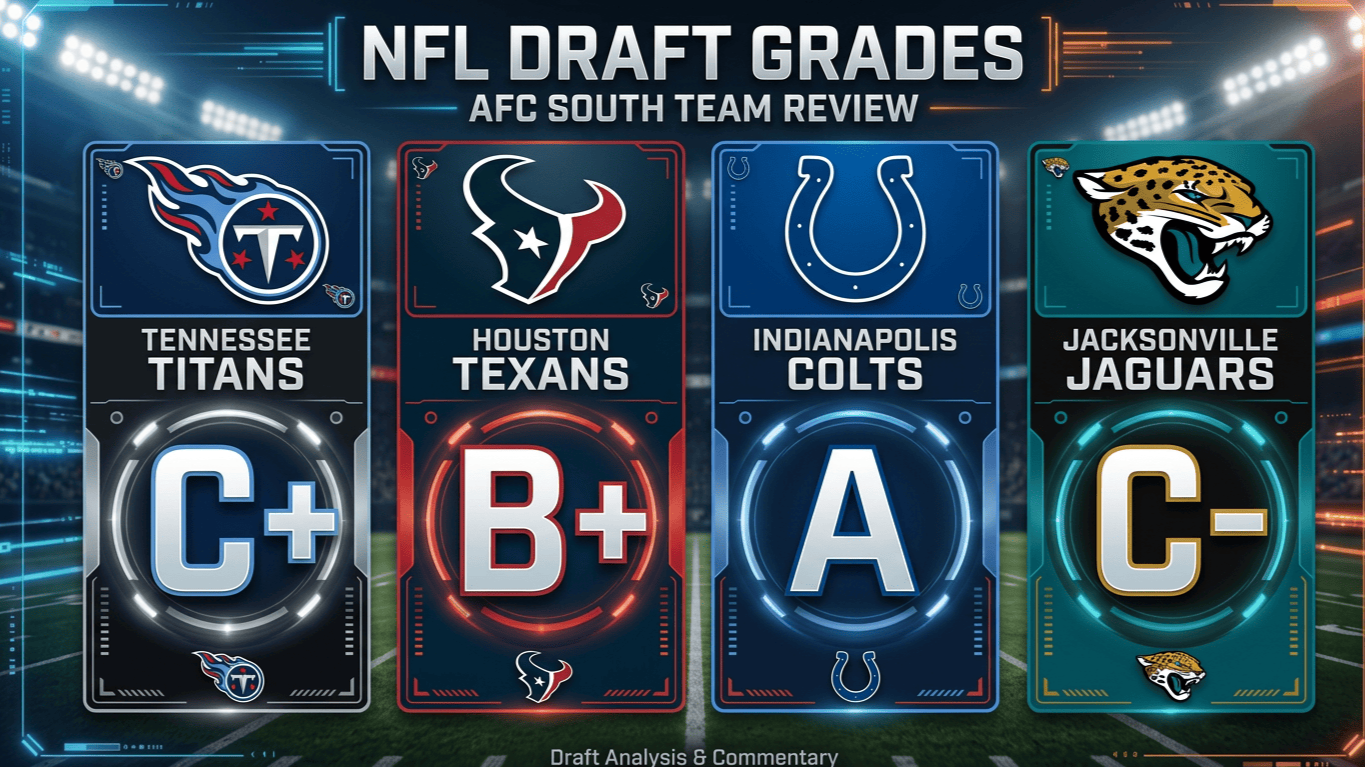
The AFC South draft landscape was defined by contrasting strategies, with some teams prioritizing stability and fit while others gambled on upside and athletic traits. From the Colts’ polished, need-based approach to the Jaguars’ risk-heavy class, this division saw a wide range of philosophies that could significantly impact its future. Here’s how each team fared and what it means heading into the season.
Tennessee Titans
Grade: C+ (B+ if the ceiling is hit)
The Titans were expected to get Notre Dame RB Jeremiyah Love at pick 4. However, the Cardinals picked him one slot earlier. Getting Ohio State WR Carnell Tate is a good consolation prize. Tate is a solid, all-around wide receiver with high-end traits. It’s a question whether he could ever be a WR1, but he is a top-level player for QB Cam Ward to target.
The Titans lacked mid-round picks and probably should have traded back for more. At pick 31, Auburn edge Keldric Faulk is a freaky athlete with immense strength and the best run defense of any edge in the draft. Second-rounder Anthony Hill Jr., LB from Texas, is a jack-of-all-trades linebacker with no singular elite aspect to his game. Faulk and Hill have the potential to be top-level starters or even Pro Bowlers, but the Titans need quantity, not quality. Trading back from pick 31 to get a late second-rounder and a late third-rounder would leverage this draft’s depth. For instance, still getting Anthony Hill Jr., but adding plug-and-play Oregon guard Emmanuel Pregnon and Auburn edge Keyron Crawford instead of only Faulk.
The Titans added some decent depth later. Fifth-round Arkansas Guard Fernando Carmona is a versatile backup lineman with rough technique but solid effort. Sixth-round Indiana Center Pat Coogan has a low ceiling, struggling with power rushers and lacking agility, but will be a good locker room presence. Penn State RB Nicholas Singleton has tons of athletic tools, but regressed in 2025 because he lacks top-end instincts and feel for finding openings. Baylor DT Jackie Marshall is a similar story, pro speed and power for his size, but regressed in 2025 and struggled to effectively use his tools. Oklahoma TE Jaren Kanak is athletic but only started playing tight end this past year, which shows in his poor, raw run-blocking.
The Titans got plenty of athletic prospects with acceptable ceilings, but lack clear paths to help them reach their potential, especially on a struggling team with few institutional mentors to guide the rookies.
Houston Texans
Grade: B+
The Texans needed to add to their offensive line and interior defensive line. Their first two picks, Georgia Tech guard Keylan Rutledge in the first round, and Ohio State DT Kayden McDonald, were great selections. Rutledge was a bit of a reach at pick 26, but his versatility, grit, and durability are what the Texans need. Their offensive line added three proven veterans this offseason, and adding someone who can not only start but shift positions depending on injury is a smart move.
Kayden McDonald is the perfect fit for what the Texans’ defensive tackle room needed. He is a massive run-stuffing tackle who, if his development continues, can cover two gaps with ease. The Texans’ defense is already an elite pass-rushing unit and adding someone to succeed Sheldon Rankins while beefing up the run defense complements the line perfectly.
The Texans did reach in selecting Michigan TE Marlin Klein late in the second round. However, tight ends were being selected early, and while Klein is very raw with only 12 college starts, he was voted team captain for a reason. The rest of the Texans’ picks filled out the roster with solid depth, but the top picks really made their draft. CJ Stroud has a stronger supporting cast and has a great chance to return to his rookie form.
Indianapolis Colts
Grade: A
After a year of inconsistency and up-and-down play, the Colts needed reliable, stable players. They certainly found that in the draft. Their middle linebacker position was a concern until they added Georgia LB CJ Allen and Oregon LB Bryce Boettcher. Allen isn’t elite or flashy, but his leadership at Georgia, his IQ for being in the right place at the right time, and excellent tackling are all valuable assets for the Colts. Boettcher is similar to Allen; he isn’t a top-level athlete, but his motor runs white hot. He can’t read offenses like Allen, but fans will love his commitment to big hits.
Staying on defense, LSU safety AJ Haulcy is an old-school strong safety. He is an instinctive downhill tackler who can still hunt down the ball. He had 10 career interceptions. Additional late-round picks in Florida edge George Gumbs Jr. and Ohio State edge Caden Curry will be solid developmental prospects.
On offense, the Colts added Kentucky guard Jalen Farmer, a great run blocker with the tools to develop into a long-term starter. Kentucky RB Seth McGowan hasn’t shown explosive runs, struggles in the passing game, and has a fumbling issue, but his agility and IQ make him an ideal short-yardage curveball to throw at defenses. Oklahoma WR Deion Burks struggled to put it all together in college, but his 4.3 forty and impressive athleticism were great value at the end of the seventh round. Burks is the high-ceiling, low-floor type of pick that doesn't always pay off, but he has all the tools to be great if he does develop. Finding players who fit needs, adding depth, and rounding out roster skill sets are what GMs hope to get out of the draft. The Colts did very well.
Jacksonville Jaguars
Grade: C- (If there are no starters in 3 years: F)
The Jaguars were quiet in free agency and quiet in the draft. Selecting Texas A&M’s Nate Boerkircher at pick 56 because of a run on tight ends hurts them. Boerkircher is a solid blocking tight end with flashes of receiving skills. He will turn 25 years old during his rookie season and will most likely be a solid backup TE2. There were prospects with more potential and better Day 1 impact available, like safety Emmanuel McNeil-Warren, edge Keyron Crawford, and WR Antiono Williams. Boerkircher is a good prospect, but teams with little draft capital can’t look at runs and instead must look at the best players available.
The Jaguars did get a solid rotational defensive tackle in Texas A&M’s Albert Regis in the third round. Fellow third-rounder Oregon guard Emmanuel Pregnon is the best prospect the Jaguars got from this draft and has the highest upside. Pregnon needs time to develop, but his physical tools could make him a Pro Bowl guard if he reaches his potential. Maryland safety Jalen Huskey, their last third-rounder, has good instincts and can read QB’s eyes, but lacks speed, agility, and acceleration. Huskey could still be a productive safety, but his physical limitations will greatly reduce his margin for error.
Later in the draft, the Jaguars selected prospects that scouts haven’t looked at closely: Duke edge Wesley Williams, Houston TE Tanner Koziol, Baylor WR Josh Cameron, Stanford WR CJ Williams, Washington edge Zach Durfee, and Middle Tennessee State LB Parker Hughes. These players were not high on draft boards. That doesn’t mean they’re inherently worse. In fact, there’s a chance they were overlooked and could bring good value. However, generally it’s hard to get one moneyball-style, overlooked prospect, much less six. The Jaguars picked tons of depth at key positions, didn’t use draft pick value effectively, and need to prove scouts wrong. Fingers crossed.

Comments:
Log in or sign up to read and post comments.