2026 NFL Draft Focus: AFC North
Dysfunctional Teams Trying to Find Stability
By: Ian Stuart Martin · 5mo
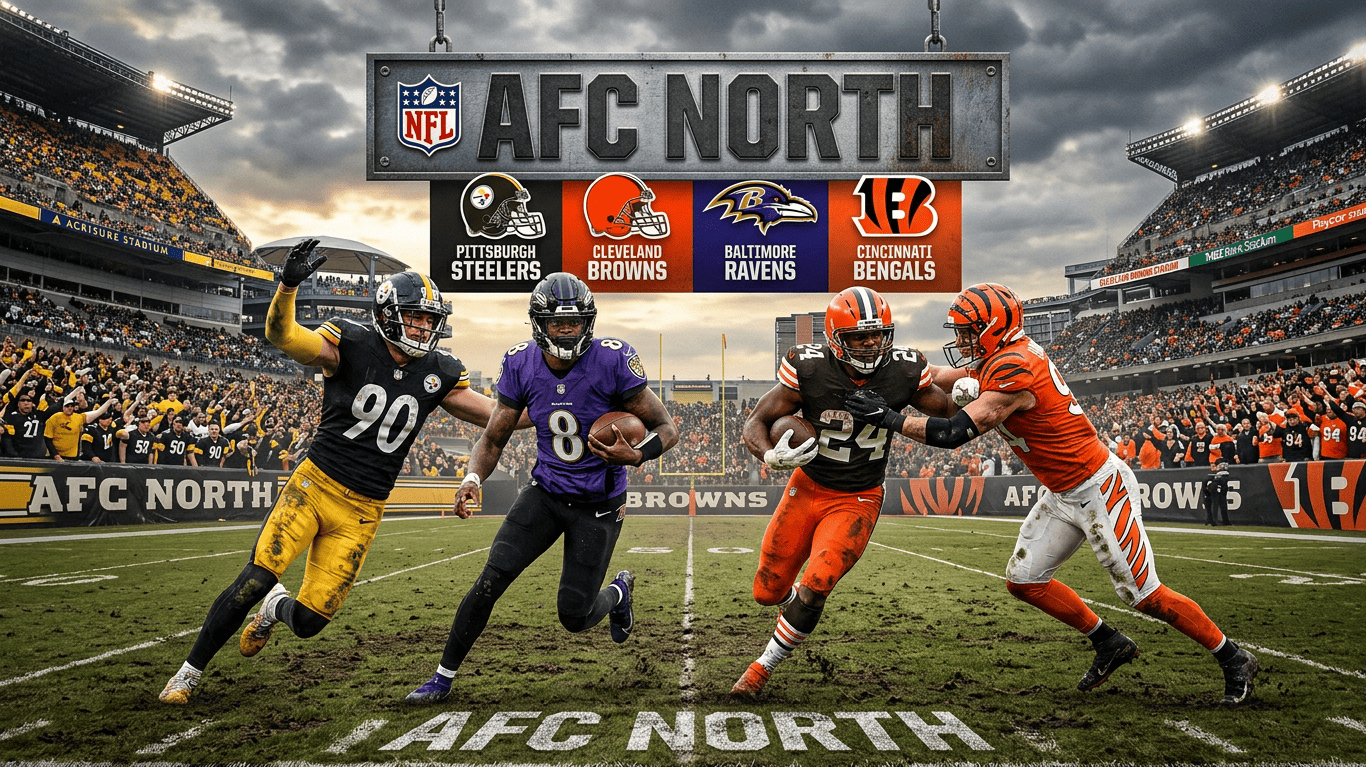
The AFC North has long been one of the most competitive divisions in football, and the 2026 NFL Draft figures to shake things up once again. With coaching changes in Baltimore and Pittsburgh, a Browns offense still handcuffed by the Deshaun Watson albatross, and the Bengals doubling down on defense, all four franchises enter draft weekend with urgent business to address. From a do-it-all wide receiver battling the injury label in Cleveland to a generational tight end prospect rewriting combine record books in Baltimore, the AFC North's draft needs are varied. However, the pressure to get it right is universal.
Cleveland Browns
New Head Coach Todd Monken and GM Andrew Berry are finally seeing the light at the end of the tunnel. The Deshaun Watson contract only has three more years. In that time, the Browns need to figure out if Shedeur Sanders or Dillon Gabriel is the quarterback of the future, solidify the offensive line, add edge depth, and build a wide receiver corps.
Jordyn Tyson (WR, Arizona State)
Jordyn Tyson is that guy. Prospects can be overlooked when a known issue becomes the only thing talked about of the player, of the person, of the human. In 2022, Tyson tore his ACL, PCL, and MCL, requiring major surgery. In 2024, he broke his collarbone, and this past October he damaged his hamstring. Tyson’s play didn’t decline after 2022 or 2024, yet the 2025 hamstring injury is considered a defining factor for him as a prospect. Because Tyson focused on recovering fully, he is judged and overlooked.
What Tyson is on the football field is a well-developed route runner. At 6’2”, 203 lbs., he has excellent ball tracking, hands, and a great catch radius. At Arizona State under Hines Ward’s tutelage, Tyson was used as a do-it-all receiver, spending time in the slot and out wide. His back shoulder is such a great target, it basically has a big bullseye on it. Complementing Jerry Jeudy, Tyson would be a bright spot on the Browns’ offense and go from “that injured guy” to their “that guy.”
Joshua Josephs (EDGE, Tennessee)
After the sixth pick, the Browns don’t pick again until the third round. There, they can find an intriguing edge prospect. At 6’3”, 242 lbs., with 34¼” arms, Joshua Josephs is light for his position. However, he has great weapons for the next level. He uses his long arms to his advantage with a destructive chop and an off-balancing push-pull. Josephs has real strength for his size, and while he’s currently limited to a rotational pass-rusher, he can develop further.
Myles Garrett is an amazing edge rusher, but to extend his longevity, the Browns need guys who can rotate in. Josephs gives them a developmental option. He started at Tennessee as a pure athlete but has improved every year. Adding weight while maintaining speed and burst will determine if he evolves beyond a rotational player. The Browns need young, up-and-coming players to help extend their defensive dominance. If Josephs can continue developing, adding more counters, polishing a spin-move, and adding weight for run defense, he could be key. He could be one of the players who carries the torch in the future.
Baltimore Ravens
John Harbaugh is gone. New Head Coach Jesse Minter and GM Eric DeCosta are running out of time. Athletic quarterbacks like Lamar Jackson aren’t known for the longevity of their prime. With the 14th overall pick, the Ravens need immediate contributors.
Kenyon Sadiq (TE, Oregon)
The Ravens finally hit on a first-round wide receiver in Zay Flowers, but need more receiving threats. Mark Andrews is aging, and last season posted the lowest receiving yards of his career.
Sadiq helps the offense in two ways. First, the Ravens can run more two-tight-end packages to open lanes for Derrick Henry. Second, Sadiq profiles as a big-bodied wide receiver. Tight ends don’t normally catch touchdowns lining up outside the numbers.
At 6’3”, 241 lbs., Sadiq made a strong argument for being the most athletic tight end prospect in the history of the combine. A combine-record-tying 4.39 forty, a 43.5” vertical, 11’1” broad jump, and a 1.54 10-yard split are rare. Sadiq gives the Ravens a versatile chess piece. He can take a jet sweep to the house, catch a back shoulder fade for a touchdown, and climb to block linebackers to open lanes.
Spencer Fano (OT, Utah)
The Ravens need more talent along the interior offensive line, and Ronnie Stanley isn’t getting younger. They can address both concerns with Spencer Fano. At 6’ 5½”, 311 lbs., Fano is one of the most agile big men in football, not just in college, but the NFL as well. He is built differently. Fano ran a 7.34 three-cone, a 4.91 forty, with a 32” vertical at, again, 311 lbs. He also added ten pounds of muscle before the combine and is only 21 years old.
However, there are arm-length concerns: He has 32⅛” arms. They never were an issue in college and shouldn’t be in the NFL. Moving him to guard for the Ravens wouldn’t be to cover his weakness; it's to cover theirs. The projected starters on the interior offensive line are third-year seventh-round pick Andrew Vorhees, second-year UDFA Corey Bullock, and seven-year journeyman John Simpson. They are all decent, but none are elite. Fano would shore up the interior line from Day 1 and be an heir apparent to Ronnie Stanley once he retires.
Pittsburgh Steelers
New Head Coach Mike McCarthy and GM Omar Khan have an aging roster and no quarterback of the future. There’s a chance Will Howard steps up, but the Steelers lack direction. With the 21st overall pick, they need to set the stage for their next franchise quarterback.
Olaivavege “Vega” Ioane (G, Penn State)
Vega Ioane is the top guard prospect in the draft. At 6’4¼”, 320 lbs., he is a broad-chested bruiser with steel-trap hands. He is the definition of plug-and-play. Ioane’s agility is only average, but everything else, from technique to anchor to strength, is top tier. He dropped weight between 2024 and 2025 and looked sharper because of it. He allowed no sacks and only four hurries this past year, moving 280-lb. defenders like they were 180-lb. cornerbacks.
The Steelers lost starting guard Isaac Seumalo in free agency. Projected starter Spencer Anderson is a fourth-year, seven-round pick. He’s been serviceable when stepping in due to injury, but isn't a long-term answer. The biggest concern for the Steelers with Ioane is whether he’ll be available at pick 21. If he falls, the only debate in the Steelers’ draft room would be who’s calling in the pick.
Dillon Thieneman (S, Oregon)
Jalen Ramsey is regressing, and outside of Joey Porter Jr., the Steelers don’t have elite playmakers in the secondary. At 6’0”, 201 lbs., Dillon Thieneman is elite. With blazing 4.35 forty speed and a 41” vertical, Thieneman is a high-IQ defensive menace. With 306 career tackles, he has a habit of showing up wherever the ball goes. The only concern is man coverage. His change of direction is average, so he loses receivers as they close distance and use sharp cuts.
The Steelers need youth and depth in their secondary. They signed veterans Jamel Dean, Jaquan Brisker, and Darnell Savage, all solid players. But they lack young starters who can keep the vets fresh so they can serve as quality rotational backs. Thieneman is a high-IQ, hustle-heavy safety who can help get the most out of the Steelers’ veteran secondary.
Cincinnati Bengals
By trading the 10th overall pick to the Giants for Dexter Lawrence, the Bengals have finally added to their defense instead of subtracting from it. But with the loss of star edge Trey Hendrickson in free agency, they still need to improve their defensive line. Head Coach Zac Taylor and GM Duke Tobin need to help the defense with the 41st overall pick.
Keionte Scott (CB, Miami)
At 5’11¼”, 193 lbs., and 25 years old in August, Keionte Scott is a unique prospect. His development is complete; what you see on tape is what you get. Scott has fluid speed, solid short-area acceleration, and deeply ingrained instincts. He also brings a linebacker’s mentality when tackling. His blitzing is amazing, and he displayed high IQ and great leadership at Miami. He isn’t perfect: he struggled on the outside against big-bodied receivers, and his missed tackle rate needs to improve. At the next level, Scott is a great nickel corner.
Current projected nickel Jalen Davis has bounced between the practice squad and the game day roster throughout his career. Credit to Davis, he was solid when stepping in for injuries last year. However, Davis is 30, and the Bengals ideally want to keep him fresh so he can maintain his reliability. Scott’s physicality, fierce competitive drive, and locker room leadership would help solidify the Bengals’ secondary.
Anthony Hill Jr. (LB, Texas)
At 6’2”, 238 lbs., with 32⅜’ arms and a 4.51 forty, Anthony Hill Jr. is a great athlete. Given his production this past year, 69 tackles, 4 sacks, 7 TFLs, and 2 interceptions, it’s strange to see Hill often mocked in the second to third rounds. The reason is how Texas used him. He was a ball-seeking missile who covered well and ran to the action fast, but his success didn’t necessarily come from instincts or reading a play. This isn’t Hill’s fault; Texas never pushed him to develop a deeper game. But how well he can translate to an NFL team’s complex schemes is a question that needs answering.
The Bengals drafted their young linebacker duo in 2025 with Demetrius Knight Jr. and Barrett Carter. Both struggled heavily with coverage and missed tackles. Hill is in a similar mold, super athletic and incredibly fast. But he brings much better coverage ability and more secure tackling. His potential to evolve when asked to do more, develop his instincts, and step in as the best linebacker on the Bengals makes Hill a solid selection if available at pick 41.

Comments:
Log in or sign up to read and post comments.