2026 NFL Draft Review: AFC North
Three New Head Coaches, Two Rush to Contend and One Faces Rebuild
By: Ian Stuart Martin · 5mo
The AFC North is split between contenders and rebuilders. The Steelers and Browns are hunting for franchise quarterbacks. The Bengals and Ravens have top-5 QBs who need help. All four teams made major roster changes through the draft.
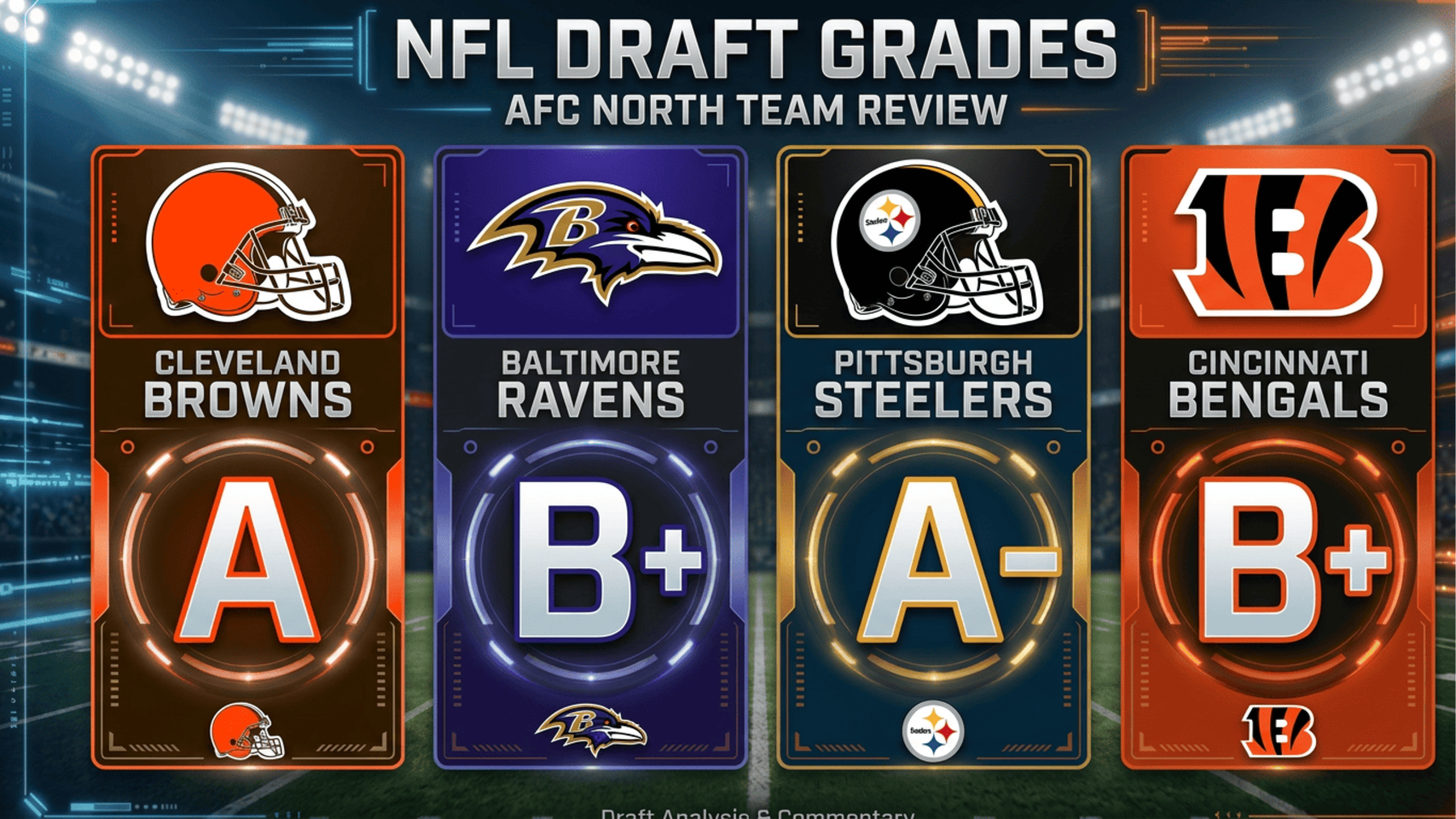
Cleveland Browns
Grade: A
Having multiple top-50 picks biases grading, but the Browns crushed every selection. At 9th overall, they took Utah OT Spencer Fano. Fano is a special athlete who moves like a tight end with a roaring motor and solid technique. The offensive line overhaul with four new starters will pay off for whoever wins the QB competition.
At picks 24 and 39, they added two starting receivers with complementary skills. Texas A&M’s KC Concepcion is a slot YAC specialist and elite return threat. Concepcion is like Makai Lemon, but shiftier and less sure-handed. Washington’s Denzel Boston is a big outside X-receiver for stretching the field. He lacks WR1 route running, but contested-catch specialists are a premium for a reason.
Toledo safety Emmanuel McNeil-Warren was a massive steal at 58. He’s an old-school downhill strong safety with sure tackling, underrated timing, and play recognition. However, he isn’t a coverage guru, and scouts ding him due to his below-average agility. At 86, Miami OT Austin Barber lacks anchoring ability against NFL-level power rushers, but his agility and movement make him an ideal swing tackle.
Day 3 focused on high-floor players. Fifth-rounders Alabama’s C Parker Brailsford and LB Justin Jefferson are undersized but athletic and durable. Fifth-round Cincinnati TE Joe Royer spent six years in college but still looks raw and needs to improve his route running and blocking technique. Seventh-round BYU TE Carsen Ryan has less athleticism, but he has a motor and intriguing receiving skills.
The only questionable pick was Arkansas QB Taylen Green in the sixth round. He is supremely athletically gifted, but much like Colts’ Anthony Richardson, his processor, technique, and consistency are poor. The Browns already have three QBs under contract. Still, every pick was made with a cool head. They didn’t give in to player position runs, added talent to an already elite defense, and worked to add to their offense.
Baltimore Ravens
Grade: B+
The Ravens are trying to keep Lamar Jackson’s championship window open. They left the draft with several window extenders. In the first round, Penn State G Vega Ioane filled the massive hole at left guard. Despite losing C Tyler Linderbaum in free agency, the line could be better. Ioane is that good. He is a fun man-mover and near-generational prospect who will play for a decade.
At picks 45, 80, and 115, the Ravens address two major needs. At 45, Missouri edge Zion Young is a great partner to Trey Hendrickson. Young is a gritty, edge-setting rusher with oodles of power. He fits the Ravens’ historically grinding mentality. Once he adds counters and finesse to his rush plan, he will become a top second edge.
Picks 80 and 115 targeted an outside receiver to pair with WR1 Zay Flowers. USC WR Ja’Kobi Lane is a big, speedy contested-catch aficionado who struggles with everything else. Indiana WR Elijah Sarratt is also a contested-catch threat but lacks speed, winning with physicality. Neither is a finished product, but could take over red-zone duty from the aging Mark Andrews.
The rest of the draft was underwhelming. They added quality special teamers with some upside. SMU TE Matthew Hibner is an undersized, high-motor TE3 with good speed and length. His below-average weight and agility keep him on special teams. Duke CB Chandler Rivers lacks height and weight but compensates with IQ and agility. He could become a starting corner, but his size leaves little margin for error. Alabama TE Josh Cuevas is a blocker with flashes of NFL wiggle.
Clemson RB Adam Randall only has one full season at RB after converting from WR. He is an athletic ball of clay to mold into a third-down specialist or RB2. Michigan DT Rayshaun Benny is a tweener between nose tackle and defensive end. He has two polished moves, a power move and a counter, he eats blocks, but needs to add more weight for DT or more moves for DE. Northwestern G Evan Beerntsen is an undersized, well-polished seven-year college player. Michigan State P Ryan Eckley is a punter with good production.
The Ravens had a respectable draft with good fits. However, their later picks lacked upside swings. Randall and Benny could work out, but their ceilings are only as rotation players or high-level backups. The Ravens got long-term pieces from this class. Only time will tell if it’s enough to get Lamar to a Super Bowl.
Pittsburgh Steelers
Grade: A-
The Steelers need identity and direction. Kenny Pickett wasn’t the answer, but the team kept trying to be playoff contenders despite a clearly aging, thin roster. Now they have accepted the rebuild and focused on adding high-potential players.
At pick 21, they selected Arizona State OT Max Iheanachor. He started playing football in college. He has impressive athleticism, but because of only five years of total experience, his technique needs work. Second-round Alabama WR Germie Bernard is a jack-of-all-trades, master of none. He has the size, speed, and agility to be a strong WR2, but nothing that jumps off the film. Third-round Iowa G Gennings Dunker has excellent power and size, but his agility is forcing him from tackle to guard. He will need time to acclimatize.
The Steelers later targeted players with major concerns but potentially major rewards. Penn State QB Drew Allar is raw, chock full of talent, and coming off a season-ending left ankle break. He will compete with second-year quarterback Will Howard for the backup role for Aaron Rodgers. And if Mike McCarthy is still the “QB whisperer,” one of the two could become the franchise starter. Georgia CB Daylen Everette can be elite, but he was never more than above-average in three years of starting. If the Steelers tap his potential, pairing him with Joey Porter Jr. would be a scary sight for offenses.
Iowa WR Kaden Wetjen is an elusive return specialist who needs scheming to counter his lack of size and arm length. Indiana TE Riley Nowakowski fills the Connor Heyward role as a high-energy fullback/H-back. Notre Dame DT Gabriel Rubio looks like an NFL DT, but has only 8 college starts. He is a big unknown with limited tape, but he flashed an elite mix of size, strength, tackling, and aggressiveness.
With their final picks, the Steelers added prospects that reflect their new direction. Oklahoma S Robert Spears-Jennings has insane testing numbers, but desperately needs better instincts and play recognition. Navy RB Eli Heidenreich lacks acceleration and speed but has the potential to be a solid gadget player under offensive Head Coach Mike McCarthy. The Steelers added prospects with sky-high ceilings to help them replace veterans as they age.
Cincinnati Bengals
Grade: B+ (with Dexter Lawrence Trade: A)
The Bengals desperately needed defensive help. Joe Burrow and Zac Taylor had the offense running perfectly last year, but the defense dragged the team down. Trading the tenth overall pick for Dexter Lawrence was amazing. Lawrence had a down year last year due to a nagging injury but had been generational prior.
At the 41st overall pick, Texas A&M edge Cashius Howell joins Lawrence, Myles Murphy, and Boye Mafe. That turns around the defensive line entirely. Losing Trey Hendrickson to the Ravens was a big blow, and the Bengals needed pure pass rushing. Howell is that guy. He has great speed, agility, and bend, but can be targeted in the run due to his size. The rest of the Bengals’ edges can defend the run, so adding a curveball like Howell is like a cherry on a sundae, it isn’t complete without the cherry.
The Bengals reached on third-rounder Washington CB Tacario Davis. This is because their secondary struggled to tackle last year. For all his warts (lack of stickiness, average agility, too much hand usage), he is one of the best tackling corners in the draft. Reliable tackling is a premium for Cincinnati, and Davis has the long speed to pursue.
Navy DT Landon Robinson was the only other defensive player taken. In the seventh round, Robinson is small, quick, and strong but not elite at anything. He can become a rotational player if he continues polishing his technique.
The Bengals used the rest of their picks on the offense. Auburn C Connor Lew was a steal in the fourth round. Lew has the highest potential of any center in the draft. He is raw and coming off injury, but his athleticism will make him Joe Burrow’s future center in a couple years.
Georgia WR Colbie Young has an NFL body and has great yards-after-catch ability, but his route running is slow and there are character concerns from 2024. Duke G Brian Parker II has only ever played tackle, but his technique and movement make him an ideal guard. He has the flexibility along the line. Even if he doesn’t develop, he will be a reliable long-term backup interior offensive lineman. Texas TE Jack Endries is a total project who needs coaching and added weight, but despite his sloppiness, he had three years of consistent college production.
The Bengals had little draft capital after trading for Dexter Lawrence, but they addressed their defense and added prospects to keep the offense fresh. If they hadn’t reached so heavily on Davis or added more high-floor defensive depth, their grade could be higher. They used this offseason to reorganize and spread out money rather than paying only Hendrickson. Instead, they added several starters and drafted well.

Comments:
Log in or sign up to read and post comments.