2026 NFL Draft Review: NFC East
One of the NFL’s Most Storied Divisions Scores High in Pittsburgh
By: Ian Stuart Martin · 5mo
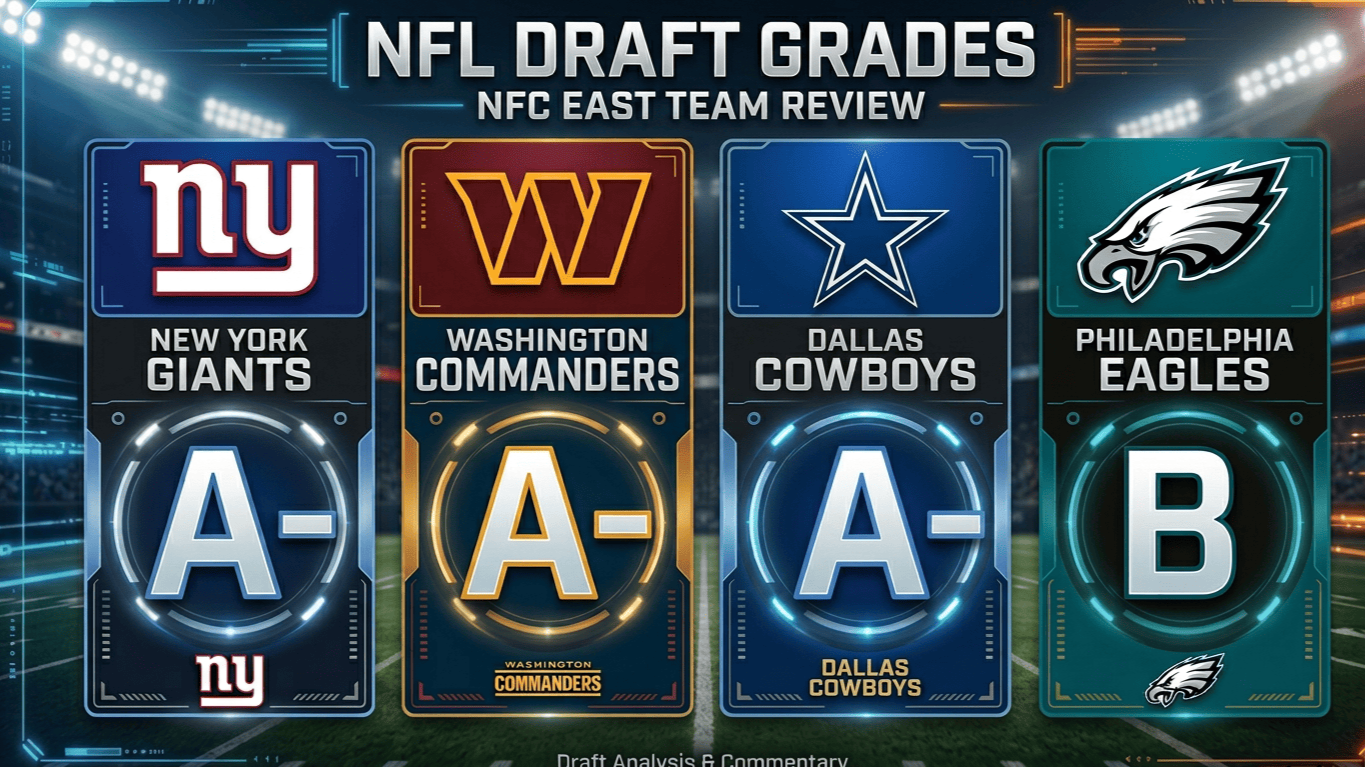
The NFC East carries major legacies for each of its franchises. Every team had regressed from previous form this past year, and all need to rebound. Surprisingly, nearly every team in the NFC East came away with impressive classes. Ian Stuart Martin breaks down how each team’s draft addresses their needs.
New York Giants
Grade: A-
The Giants traded away Dexter Lawrence for the tenth overall pick. New Head Coach John Harbaugh started off his tenure by securing some of the draft class’s most promising prospects to develop. In the first round, the Giants selected Ohio State LB Arvell Reese and Miami OT Francis Mauigoa. Reese has the flexibility to play middle linebacker or edge. With the Giants’ depth at edge, Reese will more likely play as the will linebacker. Over time, Reese could transition to edge but using him now as a reliable linebacker while slowly improving his edge skills gives the Giants a valuable prospect who doesn’t need to rush his development. Francis Mauigoa was the most polished tackle in the draft. With the Giants, he has the flexibility to slide over to start at right guard and is the long-term replacement for Jermaine Eluemunor.
On Day 2, they addressed the cornerback and wide receiver positions. Tennessee CB Colton Hood is an excellent press corner who gives the defensive back room some real teeth and adds insurance if Greg Newsome’s one-year prove-it deal backfires. Notre Dame WR Malachi Fields lacks high-end speed, but as a big, tall, contested-catch X-receiver, he will be a valuable asset. He projects as a solid WR2. His field-stretching will ease the burden on Malik Nabers, who is returning from a major injury last year.
On Day 3, the Giants added depth and developmental projects. Auburn DT Bobby Jamison-Travis has size and athleticism, but he has to learn to break some bad habits and overcome poor technique before he can see the field. Illinois OT JC Davis is a durable older prospect with pro-level strength, but he needs to improve his hand usage. He will be a dependable backup early on with the ability to become their sixth lineman and first substitute off the bench. Finally, BYU LB Jack Kelly is a capable special teamer with room to grow into a backup linebacker. Overall, the Giants had a quality draft that didn’t fill out their roster with talent entirely, but did address areas of concern with foundational pieces now in place to grow.
Washington Commanders
Grade: A-
Going from a team with tons of picks to one with few picks, the Commanders are similar to the Giants in securing key prospects with the draft capital they had. Starting their draft with Ohio State LB Sonny Styles was perfect. Styles is a do-it-all middle linebacker who can solidify Dan Quinn’s defense. He has virtually no major weaknesses; his coverage, tackling, athleticism, and instincts are all elite.
On Day 2 and Day 3, the Commanders added developmental projects and depth. Clemson WR Antonio Williams is a standard slot receiver. He has excellent after-the-catch ability, good separation, acceleration, elusiveness, and he produced throughout his college career. Outside of some injury concerns and needing to polish his route running further, he will give Jayden Daniels a reliable relief valve as a WR2. Tennessee edge rusher Joshua Josephs has impressive length and quickness. He will need to add more moves, but his jams and stiff arms with 34¼” arms make him a rock-solid designated pass rusher. He won’t be more than that until he adds weight to handle run defense.
Late in the draft, they added Penn State RB Kaytron Allen, Michigan State C Matt Gulbin, and Rutgers QB Athan Kaliakmanis. Allen is a high-floor running back with consistent production at Penn State. He lacks explosiveness and isn’t a receiving threat, but his football IQ, contact balance, and size make him an ideal backup on first and second down. Gulbin is a dependable three-year starter with average athleticism and short arms. He will struggle at the next level, but viewing him as a developed, reliable backup interior offensive lineman makes him a reasonable pick. Kaliakmanis has a strong arm and processes well, but his poor agility limits him. As a backup who can step up when needed, he will be serviceable.
Overall, the Commanders added starters with their early picks, mixed in developmental and high-floor selections later, all culminating in a strong draft.
Dallas Cowboys
Grade: A-
The Cowboys had a ton of holes to fill this offseason. Their defense resembled Swiss cheese last year. They addressed it by adding athletic prospects to complement the handful of top veterans already on the roster. Trading up to the 11th overall pick, the Cowboys selected Ohio State safety Caleb Downs. Downs is one of the premier prospects in the class. He has elite athleticism, elite instincts, and incredible versatility as a defensive back. He allows the rest of the defense to play more freely by covering up weaknesses. With their second first-rounder, the Cowboys added UCF edge Malachi Lawrence, a pure pass rusher with eye-popping explosiveness. He has the athleticism to be a capable run defender but never seemed to apply himself in the run game at UCF.
In the third round, the Cowboys selected Michigan edge Jaishawn Barham. He is a raw prospect with all the athleticism to succeed in the NFL with proper coaching. Barham also adds a wrinkle: he can play as a traditional edge as he did in 2025, but in 2024, he showed surprising coverage skills as a second-level linebacker.
Later picks added depth. Penn State OT Drew Shelton has elite agility and movement, but struggles to generate power; he may need to move inside to leverage his strengths. Florida CB Devin Moore has the traits to succeed as a press corner, but has been limited by injuries in three of his four college seasons. Alabama edge LT Overton has tons of power but lacks speed; he is projected to move inside to defensive end to use his power more effectively.
Finally, the Cowboys took a flyer in the seventh round with ECU WR Anthony Smith, who had two years of above-average production and has a chance to develop into a big-bodied X-receiver. Or he could just as easily be a speedy, strong gunner on special teams. Smith is indicative of the Cowboys’ later draft. They needed youth and targeted players like Anthony, who had athleticism requiring coaching polish.
Philadelphia Eagles
Grade: B (A- if Jalen Hurts throws over the middle.)
The Eagles and Howie Roseman did the smart thing, and added depth and developmental prospects to keep their offense loaded with talent. Jumping Pittsburgh to select USC WR Makai Lemon may prove to be genius in the long term. Lemon fell unexpectedly and is a dangerous weapon from the slot with rare yards-after-catch ability. The Eagles added another receiving threat in Vanderbilt TE Eli Stowers in the second round. Stowers is more of a pure receiving tight end and lacks pro-level run blocking skills at this point. Given the run on tight ends in this draft, getting someone to learn under Dallas Goedert should prove valuable when the crafty veteran moves on.
In the third round, the Eagles landed developmental prospect Miami OT Markel Bell. Bell is a giant at 6’9”, 346 lbs., but lacks mobility due to his size. But at a certain point, powerful and deft hand usage with a massive wingspan can compensate for his lack of agility. He needs to improve his footwork to handle inside moves and speed rushers, but the Eagles are the sort of team that can sit and develop him into a gem. NDSU QB Cole Payton is a running QB out of the fifth round who needs major work on his mechanics before he can be a reliable backup.
Late in the draft, the Eagles added Georgia guard Micah Morris, an athletic big guard who needs to break his habit of playing way too upright. Texas Tech safety Cole Wisniewski will be a special teamer with the potential to play a strong safety role. Nigerian athlete Uar Bernard has never played football, but his testing numbers are extraordinary. If the Eagles can develop his skills, his athleticism could earn him a rotational role. New Mexico edge Keyshawn James-Newby lacks size and speed, but his motor and ferocious hunger for the ball could make him a top-level special teamer.
The Eagles didn’t have their usual flashy draft, but they used their existing depth to add high-ceiling prospects they can take their time developing. The one question mark for 2026 is Jalen Hurts. He doesn’t target the middle of the field nearly as often as needed to make Lemon and Stowers work. The Eagles could add a new dimension to their offense, but Hurts needs to show he will utilize Lemon once AJ Brown is traded away in June.

Comments:
Log in or sign up to read and post comments.