2026 NFL Draft Review: NFC North
Lions, Vikings Trying to Tilt the Balance Back
By: Ian Stuart Martin · 5mo
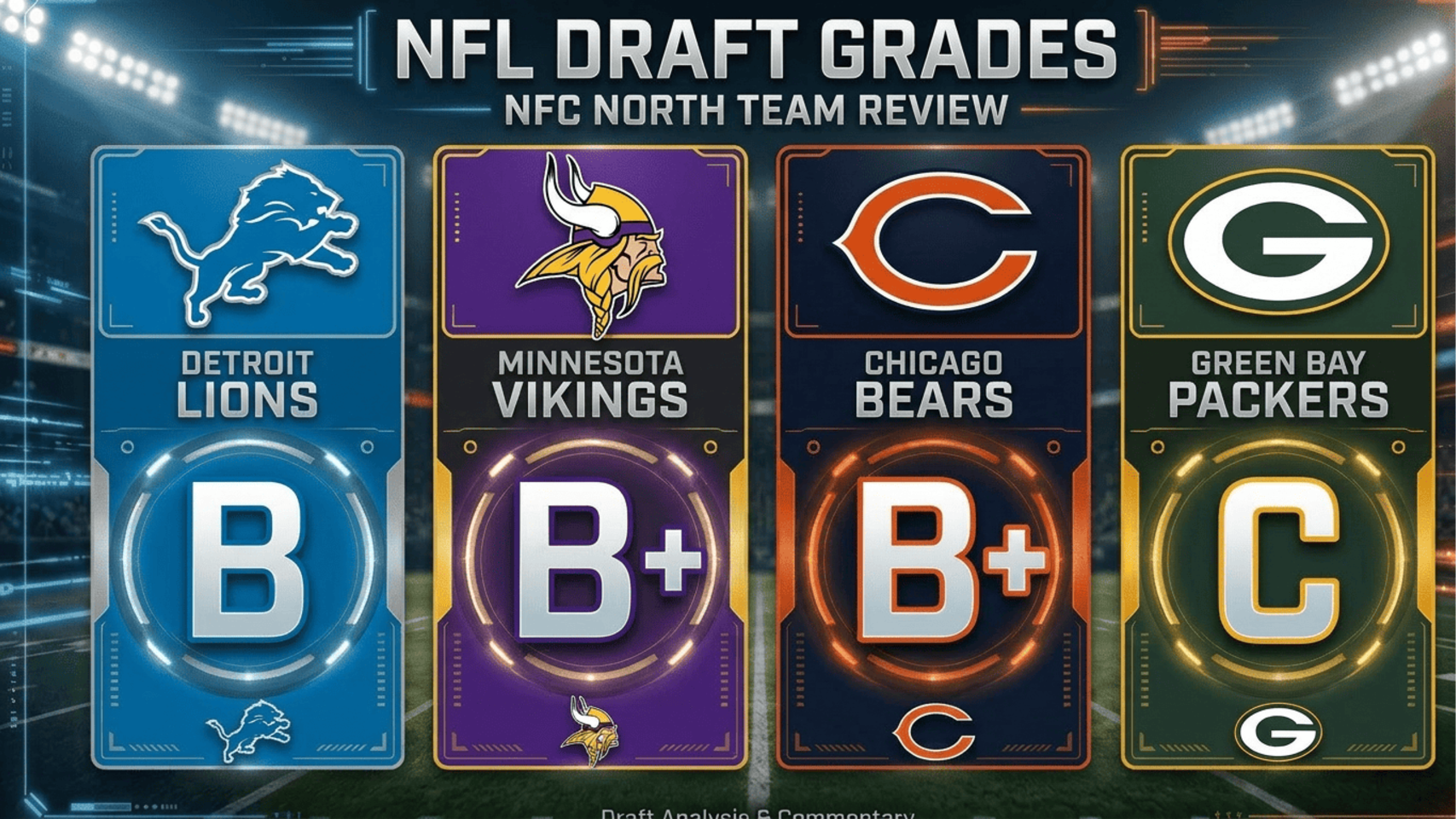
The NFC North is one of the most balanced divisions in the NFL. Every team finished above .500. Each came to the draft looking for difference makers to tip the scales. The division looks drastically different than it did at the start of last season.
Detroit Lions
Grade: B
With Taylor Decker’s retirement, the Lions needed a tackle. At 17th overall, they selected Clemson OT Blake Miller. Miller is a cultural fit, durable, and a pass protection monster. He is pro-ready and has room to improve his run protection. With Penei Sewell moving to left tackle, Miller can slot in at his natural position at right tackle.
The Lions also need an edge rusher opposite Aidan Hutchinson. They lost breakout edge Al-Quadin Muhammad in free agency. Trading up for Michigan edge Derrick Moore was a reach, but Moore has potential. He is one-dimensional, utilizing his long arms to swim and beat slower tackles but he needs time to develop a deeper pass-rushing repertoire. If he develops additional moves and improves his run defense technique, he could become an ideal No. 2 edge.
The Lions love linebackers. They professed this love by selecting Michigan LB Jimmy Rolder. Rolder is a run defense specialist with great play recognition and textbook tackling. His athleticism caps his coverage ability, but he’ll excel on first and second down. Arizona State CB Keith Abney II is another high-IQ defender who reads QBs like books. He is an aggressive press corner who compensates for average athleticism with metric tons of effort.
Fifth-rounder Kentucky WR Kendrick Law and seventh-rounder Tennessee edge Tyre West are athletic projects. Law had the majority of his catches behind the line of scrimmage. If his explosiveness and speed can be harnessed with improved route running, he will be a steal. West had five starts over four years at Tennessee. He’s a tweener with the frame of a defensive tackle but the motor and speed of an edge.
Texas Tech DT Skyler Gill-Howard, in the sixth round, represents the Lions’ draft approach. He is undersized and lacks elite athleticism, but he’s like the Energizer Bunny. He wins with constant pressure and drive. The Lions drafted Dan Campbell-style knee-cap biters with high motors on nearly every pick. Most were reaches, but they landed with a team that values their never-quit attitudes and wants them to succeed.
Minnesota Vikings
Grade: B+, (if Banks is healthy, A-, if Banks is injured, B-)
The Vikings’ defensive front lost key pieces Javon Hargrave, Jonathan Allen, and Jonathan Greenard. They left the draft with two starting defensive tackles: Florida DT Caleb Banks in round one and Iowa State DT Domonique “Big Citrus” Orange in round three. Banks is the highest upside defensive tackle in the class, with the size, athleticism, and presence to rush the passer and defend the run. However, injuring and re-injuring the same foot last year is a major red flag. Orange is like a big stone in a raging river. He can get bounced around, but he is a massive impediment to anything in front of him. He lacks a pass rush, but as a nose tackle, he will close gaps and stone wall HB dives.
The defense got more help in the second round with Cincinnati LB Jake Golday. Golday is still learning the position, but his raw athleticism and sideline-to-sideline range in the hands of DC Brian Flores will be fun to watch. Miami S Jakobe Thomas is another solid run defender who stepped up in the playoffs for Miami this past year. His missed tackle numbers are a concern, but if he can clean up his technique, he has starting potential. The final defensive selection was CB Charles Demmings out of Stephen F. Austin State. He has the speed to be a long-term gunner. He must prove the lower level of competition in the regional Southland Conference didn’t inflate his stats and that he can harness his pro-level athleticism.
On offense, the Vikings added depth to the offensive line and replaced a franchise cornerstone. Northwestern OT Caleb Tiernan is a massive 6’7” swing tackle and “break glass in case of emergency” starter taken in the third round. With an injury-prone Christian Darrisaw and Brian O’Neill having one year left on his contract, Tiernan can step in when needed and has traits to become a starter. Vikings Pro Bowl FB C.J. Ham has hung up the cleats. Michigan FB Max Bredeson, in the fifth round, is the heir apparent.
Wake Forest RB Demond Claiborne adds an explosive punch to the aging running back room. Claiborne is undersized, but his panicked running style is a nice change of pace from the power of Aaron Jones. The final Vikings selection was seventh-rounder Cincinnati C Gavin Gerhardt, a durable three-year captain. If he exceeds his draft position, starting center Blake Brandel could be replaced.
The Vikings’ defense has undergone a major overhaul. The grade hinges heavily on Caleb Banks’ health. He has the potential to be a game wrecker who can collapse the pocket and blow-up run plays. The Vikings have gotten younger and cheaper on defense. They can now invest the next several years in their struggling offense. Either they will rally around a revived Kyler Murray, or they will use the savings to shore up the battered offensive line and prepare for a future first-round quarterback.
Chicago Bears
Grade: B+
Second only to the Bucs getting Rueben Bain Jr., the Bears got the steal of the draft in Oregon S Dillon Thieneman in the first round. Thieneman is a rangy, versatile safety with elite athleticism. Pairing free agent ballhawk Coby Bryant with Thieneman gives a strong shell to any coverage scheme the Bears run.
The Bears addressed center in the second round with Iowa C Logan Jones. A four-year starter who won the Rimington Trophy as the nation’s top center, Jones is ready to start. However, fellow Rimington Trophy winner Garrett Bradbury, 31, has one more year left before passing the reins. Jones is mechanically sound and could push Bradbury out to start his long tenure early.
With their two third-round picks, the Bears focused on offensive skill positions. Stanford TE Sam Roush was used primarily as a blocker, but combine testing shows an explosive athlete whose pass-catching potential hasn’t been unveiled. Roush needs to work on his hands, but in two years, when TE2 Cole Kmet’s contract expires, Roush could replace him. LSU WR Zavion Thomas is the new return specialist for the Bears. Thomas’s route running keeps him from starting on offense, but if he tightens it up, he could form an elite pairing with Burden and Odunze.
Texas CB Malik Muhammad is agile, speedy, and reads routes well, but he gets bullied off the ball by big receivers. Taken in the fourth round, Muhammad has the traits, but learning to handle physical receivers will be key to his development. Fellow fourth-rounder Arizona State LB Keyshaun Elliott is the opposite. He has the size and motor to tackle anyone, but his speed and mobility are average.
It took Georgia Tech DT Jordan van den Berg three years as a backup at Penn State to put it all together, but his past two seasons have been productive. Berg’s energy is infectious. He gives his all on every snap. He may be a special teamer, but he could become a solid starter if his hand usage and technique maintain the momentum from Georgia Tech.
The Bears didn’t add any splash players outside of Dillon Thieneman, but they added dependable depth. For a team on the upswing with Caleb Williams hitting his stride, it’s the safe draft needed to insulate against injuries derailing the season.
Green Bay Packers
Grade: C (with Parsons’s trade: B)
The Packers entered with limited draft capital after trading this year’s and next year’s first-round picks along with Kenny Clark for Micah Parsons. Parsons was worth it and massively improved the Packers’ pass rush. However, a contending team needs immediate contributors. South Carolina CB Brandon Cisse is a big boom-or-bust prospect. He has the physical tools, youth, and run defense ability, but his instincts, route recognition, and processing lag far behind. If he develops, it will take several years. Cisse is a player a patient rebuilding team should pick, not a contender.
Third-round pick Missouri DT Chris McClellan has two years of starting experience in the SEC. He has the versatility to play as a defensive end, but his get-off is poor, and his pass rush is a one-dimensional bull rush. Being able to play multiple positions and excelling at multiple positions are different. His true position is nose tackle. His power is NFL-level, but the Packers signed Javon Hargrave in free agency as their starting nose tackle.
The Packers added depth with fourth-round Penn State edge Dani Dennis-Sutton. Dennis-Sutton has elite size and explosiveness, but his consistency is poor. When locked in, he makes tackles look slow and off balance, but part of that success comes from “out-athleting” opponents. Trying the same thing in the NFL has diminishing returns. He needs coaching to iron out his pass rush and could become a Pro Bowler in four years. But the Packers are competing now.
Kentucky C Jager Burton is a versatile center with experience at left and right guard. He is a scheme fit with four years of college starting experience. Burton will be a dependable backup. Alabama CB Domani Jackson had tons of hype coming out of high school, but he struggled at USC and plateaued. He was even benched this past year due to inconsistency. He has all the talent, but the Packers need him to put it all together.
Florida kicker Trey Smack has a cannon for a leg and set the school career record for ten field goals of over fifty yards. The Packers released Brandon McManus after he missed a critical field goal in their loss to the Bears. Smack is their replacement.
The Packers are in the middle of a championship window. Many of their core players are under contract for two to four years, but they are also all in their late twenties to early thirties. Drafting project players who need mechanical overhauls and extensive reps to build instincts is counterintuitive. If it works, they can extend their window, but these selections don’t move the needle for the upcoming season.


Comments:
Log in or sign up to read and post comments.