2026 NFL Draft Review: NFC South
Saints, Buccaneers Round Out Rosters With Excellent Drafts
By: Ian Stuart Martin · 5mo
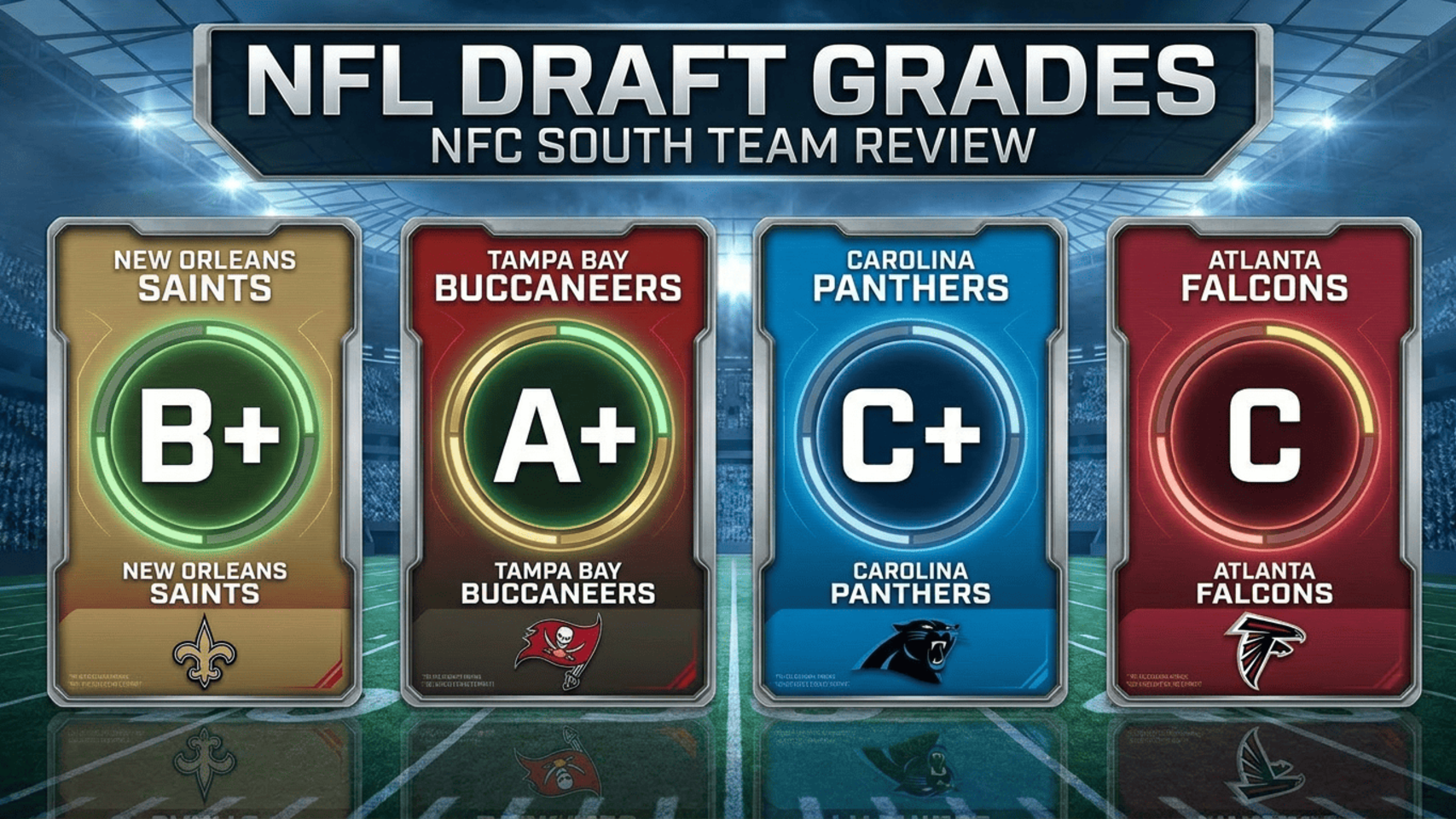
Three NFC South teams went 8-9 last year. Each showed flashes of something special but fell apart due to a lack of talent or injuries. Every team has a core and needs to add around the edges. Ian Stuart Martin evaluates each draft class.
New Orleans Saints
Grade: B+
The Saints finally hae cap space after years of massive veteran contracts and dead money. They have their future QB in Tyler Shough, and as an organization, stabilized last year. In this draft, they didn’t address edge or defensive back, but Rome wasn’t built in a day.
At 8th overall, Arizona State WR Jordan Tyson, was the obvious pick. Tyson will be an immediate upgrade to a desperate wide receiver room, with multi-role versatility and elite ball skills. Despite injury concerns, he will be deadly next to veteran Chris Olave.
Georgia DT Christen Miller in the second round is also a slam dunk. The Saints struggled against the run until they traded for NT Davon Godchaux in the 2025 offseason. Godchaux has one year left, is 31, and needs a successor. Miller is a young, high-floor talent and will be a do-it-all tackle for them. With a year behind Godchaux, he will smoothly transition into a rock-solid anchor for the Saints’ run defense.
Third-rounder Georgia TE Oscar Delp could steal the TE2 slot from free agent signee Noah Fant if his athletic fluidity translates to receiving upside that Georgia left untapped. Auburn G Jeremiah Wright is a brick wall and phone-booth-fighting extraordinaire. The fourth-rounder’s mobility is a limiting factor, but his upside is alluring.
The biggest steal of the Saints’ draft was NDSU WR Bryce Lance. He has elite separation and athleticism. He’s big, fast, and strong, but he can’t “out-athlete” NFL pros at the next level. Lance needs time to development and the Saints can be patient. The other steal was cornerback TJ Hall in the seventh round. Hall has impressive run defense and sure tackling for a corner. His long speed hurts, but as a nickel, he has the smooth feet to cover early and fill gaps.
Ohio State S Lorenzo Styles Jr. is a high school receiver turned college defensive back with lightning speed. He will produce on special teams but needs more time in the oven before taking defensive snaps. LSU WR Barion Brown will challenge Mason Tipton for return specialist duties, but like Lance, he needs route-running improvement before becoming a regular pass catcher.
The Saints’ draft has room to be incredible with all the potential they have. Much of it depends on whether their college limitations can be overcome.
Tampa Bay Buccaneers
Grade: A+
The Buccaneers hit this draft out of the park. In five years, this class won’t look as impressive compared to others. But for a team maximizing Baker Mayfield’s last few years before his litany of injuries catches up to him, the Bucs hit a home run.
The biggest move was with the 15th overall selection, they took Miami edge rusher Rueben Bain Jr. Bain could easily be the top edge rusher in this class. He has a deep well of strength packed into his “short” arms, elite bend, and a mix of pass-rush moves. Based on his draft night walk-out, he has a chip on his shoulder that would fill the Fiesta Bowl.
Longtime linebacker Lavonte David finally ran out of water from the fountain of youth and retired. Second-round pick Missouri LB Josiah Trotter will step in. He isn’t David, but he is a dependable run defender with play recognition and strength to be an immediate starter.
Another Bucs cornerstone, WR Mike Evans, is gone. Georgia State WR Ted Hurst is the vertical deep threat that was needed to at least, in part, replace Evans. Hurst has speed, strength, and long arms. On a team full of clinicians who cut up the middle of defenses, Hurst is the sledgehammer to stretch and stress them.
The Bucs got an insane steal in Miami CB Keionte Scott in the fourth round. Scott is a finished product, which is perfect for a competing team. He brings a bulldog ferocity and well-developed instincts to Tampa Bay. Another steal: Notre Dame G Billy Schrauth in the fifth round, fell down draft boards because of a mid-season MCL sprain. The injury could hurt his already limited mobility, but his in-season recovery indicates he can push for a starting job in training camp.
Clemson DT Demonte Kapehart was a rotational tackle in college and will be one in the NFL. He hasn’t shown pass rush impact in his six college seasons but adding a big-body run stuffer keeps the line fresh. LSU TE Bauer Sharp is the only player who won’t impact Year 1. Sharp is athletic and smart, but he converted from QB to TE in 2022 and remains rough around the edges.
The Bucs got high-impact college players with tons of experience, ready to play immediately. The class lacks high-end potential, but they know what they are getting. With one healthy year of Mayfield, the Bucs have a roster built for a playoff run.
Carolina Panthers
Grade: C+ (in three years B+)
The Panthers need a better supporting cast around Bryce Young. Their picks were nearly all potential-based, with some questionable fits. First-round pick Georgia OT Monroe Freeling is a good example. He has amazing upside, but he’s raw and developing. Ikem Ekwonu has been dogged by injuries, and Taylor Moton is 31. Freeling could certainly become a great tackle, but if injuries or regression hit Moton or Ekwonu, the Panthers are rolling the dice on whether Freeling is ready.
In the second round, the Panthers selected Texas Tech DT Lee Hunter, one of the top run stuffers in the draft and an ideal nose tackle. The Panthers struggled against the run last year. However, they already have a young nose tackle in 25-year-old Bobby Brown III with two contract years left. Brown struggled last year but could rebound to his 2024 Rams form. Hunter and Brown could play together, but the question is how much interior pressure they can generate on passing downs.
Third-round selection Tennessee WR Chris Brazzell II will push Xavier Legette’s starting job. Brazzell has the physical traits of a big, fast vertical outside receiver. He has flashes of finesse and feel, but Tennessee’s system asks receivers to win with athleticism. Fourth-rounder Texas A&M CB Will Lee III is in a similar boat. He’s a tall, lengthy defensive back who needs to evolve beyond his traits.
Fifth-rounder Kansas State C Sam Hecht is limited by his size, but his two strong years of top-end technique and IQ make him at least a low-end starter. Current starter Luke Fortner is on a one-year deal, and Hecht might take the job mid-season. Fellow fifth-round pick Penn State S Zakee Wheatley won’t take Tre’von Moehrig’s job, but he brings a promising skill set. Wheatley lacks Moehrig’s physicality or technical polish, but his mobility and year-over-year improvement suggest higher coverage potential.
Miami of Ohio LB Jackson Kuwatch was the Panthers’ last pick. He has only one year of elite production, but his size and speed make him an instant go-to special teamer. Like Kuwatch, the Panthers’ draft has plenty of potential early and value late. However, Bryce Young didn’t get much immediate help unless Freeling, Hecht, or Brazzell develop faster than expected.
Atlanta Falcons
Grade: C
The Falcons traded their first-round pick last year to select James Pearce Jr. That limited draft capital requires making every pick count. Avieon Terrell, AJ Terrell’s brother, in the second round was excellent value. Terrell is a great press corner who stays sticky with receivers. His long speed is a concern, but his aggressive ball-hawking production and skills will give rotational teeth to their defensive backs.
In the third round, the Falcons added Georgia WR Zachariah Branch to compete for slot receiver. Branch is very undersized at 5’8”, but his elite elusiveness, speed, and acceleration make him a premium return specialist. His route running needs honing before he can be a starter.
The Falcons selected two linebackers: Oklahoma’s Kendal Daniels in round four and LSU’s Harold Perkins Jr. in round six. Both started college at different positions: Daniels at safety, Perkins at edge. Daniels is closer to a coverage specialist but has poor positional instincts. Perkins has an amazing pass rush, but a 2024 ACL tear decreased his quickness, and his coverage skills are rough. Both have significant ground to cover before becoming more than situational rotation players.
The Falcons also selected two big project prospects. Washington DT Anterio Thompson has great strength and surprising pursuit speed, but lacks college production, and his reaction time suppresses his speed on the line. Ohio State OT Ethan Onianwa flashed elite potential while at Rice, but after a 2025 transfer to Ohio State, he got stuck as a backup and received only 97 snaps.
The Falcons’ prospects all have elite traits or high potential, but each has a fatal flaw that keeps them from being starters. A team with a young QB like Michael Penix or a revived Tua Tagovailoa needs more contributors. In addition, their interior defensive line could seriously bite them if Brandon Dorlus and Zach Harrison don’t improve to replace David Onyemata’s production.


Comments:
Log in or sign up to read and post comments.