2026 NFL Draft Review: NFC West
Selections out West Confuse Everyone
By: Ian Stuart Martin · 5mo
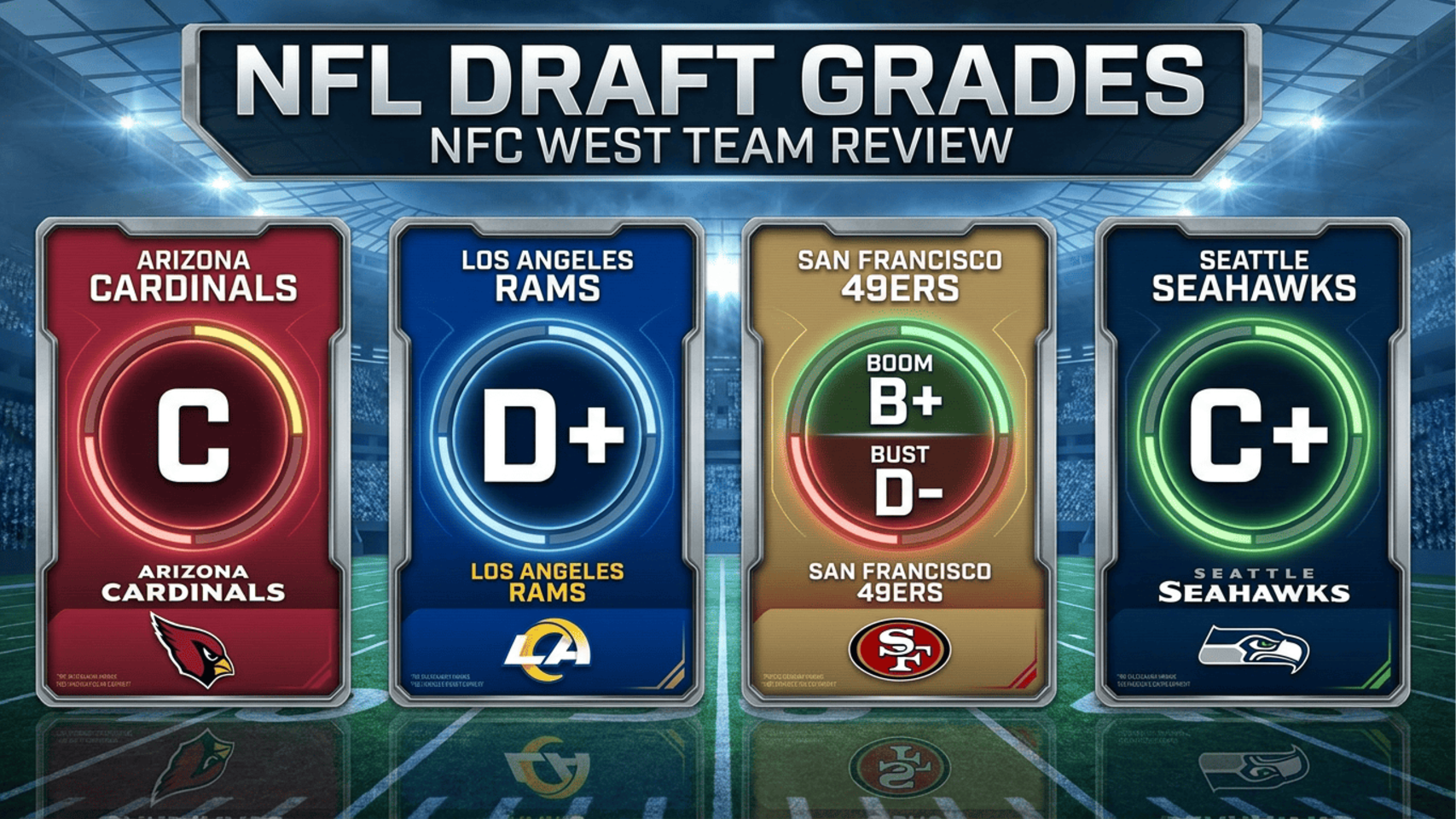
The NFC West has some of the top teams in the NFL. However, in this draft, almost all of them made strange reaches that didn’t fit traditional best practices for building a team. Ian Stuart Martin breaks down and grades how each team prepared for the next season.
Arizona Cardinals
Grade: C
Picking the best player available is normally a solid strategy. With the third overall pick, the Cardinals selected Notre Dame RB Jeremiyah Love. Love is the best prospect in this draft class, and if they had the infrastructure to use him, he would be an amazing pick.
However, the Cardinals already have a solidified running back room: James Conner, Trey Benson, and Tyler Allgeier. Elite running back prospects are great for offenses, but few running backs’ primes last into their late twenties. Wasting elite years behind struggling offensive lines and bridge quarterbacks increases injuries and removes tread. Look at Ashton Jeanty on the Raiders to see how much offensive lines and quarterbacks matter to running back success.
On offense, the Cardinals bolstered the interior offensive line with Texas A&M guard Chase Bisontis in the second round. Bisontis is an athletic guard who helps Love and should start for years. In the third round, the Cardinals reached to select Miami QB Carson Beck. Beck turns 24 during his rookie season. He’s a three-year starter with a good processor, but he still struggles with accuracy and lost arm power from a UCL tear in 2024. Beck could develop, but the Cardinals are more likely to pick a QB in the strong 2027 class, making this pick a future backup in the third round.
On day three, the Cards chose Texas Tech WR Reggie Virgil, a speedy prospect who can improve his hands and develop behind a solid WR room. Seventh-round Ole Miss OT Jayden Williams had a second meniscus surgery in January 2026 after the initial surgery didn’t take. If Williams can recover, he played well against good competition and showed his athleticism, but he needs to improve his shaky technique while recovering.
On defense, Southeastern Louisiana DT Kaleb Proctor is undersized but has great athleticism. Next to Roy Lopez, Darius Robinson, and Walter Nolen, Proctor can focus on developing his technique and worry less about double teams targeting his size. Iowa LB Karson Sharar is another high-ceiling prospect with above-average athleticism, but he is raw and undersized. Overall, the Cardinals netted solid, NFL-level talent, but the Love pick in round one may be a bit premature for the position.
Los Angeles Rams
Grade: D+ (with McDuffie trade: C-)
The Rams had few draft picks and with the team competing for a Super Bowl, they needed to get high-floor players and assets that could play right away. Instead, every prospect picked is unlikely to start for them. Alabama QB Ty Simpson is a promising prospect, but he is raw and needs to improve his accuracy. He has had flashes of NFL-level passes but needs to prove he can be both accurate and consistent.
But the big question mark lies in selecting him 13th overall, with Rueben Bain Jr., Dillon Thieneman, and Kenyon Sadiq all on the board—all of which could compete to be immediate starters. If Simpson develops or Matthew Stafford’s back finally ends his career, this selection could look better. But the Rams’ window is open now. Even if Simpson is great, will the Rams have as good a supporting cast in five years as they do today?
Later in the draft, the Rams continued to pick like a rebuilding team. Ohio State TE Max Klare is athletic, runs good routes, and can separate at the next level. However, he struggles with drops, and his run blocking is a major liability. He needs time to develop and can’t be a starter yet. Missouri tackle Keagen Trost will move to guard due to his below-average footwork and mobility. He needs time to develop, but should eventually be a solid, versatile offensive lineman with tons of strength and size. Miami WR CJ Daniels, in the sixth round, is a bet on his finesse and route running. Daniels struggles against press coverage, lacks top-end speed, and isn’t a run-after-catch threat like similar WR Makai Lemon. If he develops, he could be a reliable WR3, but until then, he can’t contribute on special teams and eats a roster spot.
The only defensive selection was Alabama DT Tim Keenan III. Keenan is a nose tackle, not a defensive tackle or end who can play nose. He’s a traditional, big-bodied wrecker. He doesn’t have the athleticism to destroy blocks, but he’s smart, has good hands, and has underrated lateral quickness to close gaps.
The Rams’ draft class is filled with potential, but with only five picks and a roster already bursting with talent, they could have targeted immediate contributors. The Trent McDuffie trade raises the grade, but only getting one immediate starter, McDuffie, with the draft capital they had is concerning.
San Francisco 49ers
Grade: Boom B+, Bust D-
The 49ers proudly said they used AI to assist with their selection process. For many of their picks, it would take an AI to explain the value. None of their prospects are bad; in fact, many are scheme fits. The 49ers even traded back, acquired additional picks, and added roster depth.
However, they could have had prospects with higher ceilings and higher floors at several spots. Take the 33rd overall pick, Ole Miss WR De’Zhaun Stribling. He has a clear early role as a speedy, big X-receiver with great run blocking skills. But Stribling struggles with separation and precise route running, yet once he has the ball, he gains extra yardage. If he works out, it could be a steal, but his weaknesses are major concerns for any wide receiver prospect going at the top of the second round. With polished X-receiver Denzel Boston still on the board at the time, this could be a mistake.
Third-rounder Texas Tech edge Romello Height has excellent athleticism and will be a great designated pass rusher, but he only weighs 239 lbs. If he adds weight, he could become more than just a one-trick pony, but until then, he will be a rotation piece. Indiana RB Kaelon Black, the other third-rounder, was a reach. Black is a high-floor prospect, but his passing game tape is almost entirely blocking, featuring no receiving. He’s a heavy-duty, compact runner who finds the hole and lowers his helmet. Beyond that, he hasn’t shown much versatility. If Christian McCaffrey goes down, his one-dimensional running is a concern.
Later in the draft, the 49ers added decent prospects with elite traits, but many come with major concerns. Oklahoma DT Gracen Halton is an undersized pass rusher who might convert to defensive end. Washington OT Carver Willis is the future sixth lineman who will bring reliable run blocking, but he struggles to maintain weight and handle power rushers. Washington CB Ephesians Prysock is a rising zone corner with solid instincts and length, but he lacks the quickness to stay sticky in man coverage at the next level. Louisiana LB Jaden Dugger recently converted from safety to linebacker. He was productive and brings elite size for the position, but he’s still learning the techniques required to play the position at the pro-level. Kansas OT Enrique Cruz Jr. is a tall, powerful tackle, but his agility is poor, and he struggles if he can’t land his punches.
The 49ers took a class of boom-or-bust prospects. If they work out, they look like geniuses. But there’s a reason most of these picks are considered reaches. They could end up with only one or two barely rotational players if the class fails to pan out.
Seattle Seahawks
Grade: C+
The Seahawks lost core pieces from their championship team to free agency. In the draft, they got replacements, but like the rest of their division, they reached on most picks.
With the 32nd overall pick, they selected Notre Dame RB Jadarian Price, the running mate of Jeremiyah Love. Price is a good runner who had to play second fiddle, not because he’s a true backup, but because the first fiddle was a generational talent. He isn’t the pass catcher or highlight-reel maker that Love is, but he’s a more consistent runner with good feel, smooth speed, and smart decision-making. Price will be a starter, but won’t be elite unless he becomes a threat in the passing game.
In the second and third rounds, the Seahawks focused on reinforcing their secondary with older prospects who can play now. TCU safety Bud Clark is a long, rangy, instinctive defensive back. He is a six-year college player with an injury history, but aside from being a bit light, he will slot right in with the Seahawks and contribute from Day 1. Arkansas CB Julian Neal is a five-year college press corner who struggles to stick with receivers as the play develops, but he will dominate early in plays.
On Day 3, the Seahawks added defensive and offensive line help: Iowa guard Beau Stephens and Minnesota DT Deven Eastern. Stephens is a scheme-specific guard with high-emd technique, but his athleticism, arm length, and lack of sustained anchor limit him. Eastern is a big guy who hits hard, but doesn’t offer much mobility, and his technique needs lots of work. Kansas WR Emmanuel Henderson Jr., Toledo CB Andre Fuller, and Arizona CB Michael Dansby are mostly solid special teamers and guys the Seahawks hope to develop into rotational players. Overall: good depth, some reaches, but nothing exciting.


Comments:
Log in or sign up to read and post comments.